A
paper published by C. Perreault and S. Mathew in PLOS ONE outlines a
new method of dating the origin of language in Africa, and therefore
the origin of language of all humans.
The
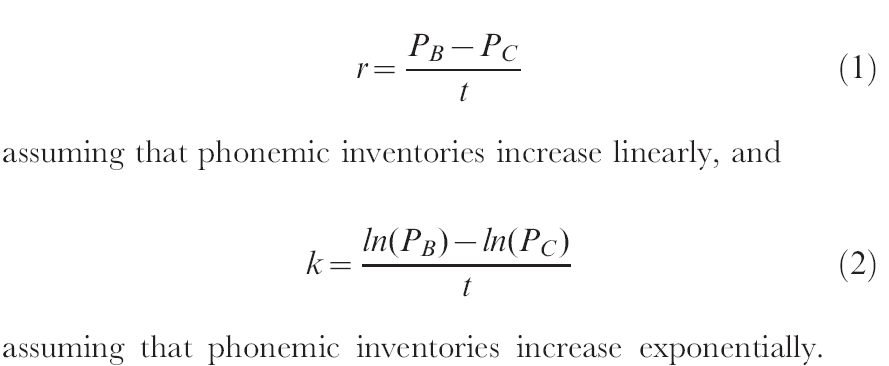
method starts by first estimating a linear (r) and exponential (k)
rate at which phonemic diversity increases with time using this
formula:
Where
t is the date of colonization and PB and PC are
the current phonemic diversity of populations B and C, where such
populations are hypothesized as follows:
"consider
the hypothetical case of two small populations, B and C, that
dispersed from the same parent population, A, t years ago (Figure 1).
Suppose that B and C are similar in size so that they both experience
approximately the same loss in phonemic diversity due to the founder
effect. Now, suppose that population B colonizes a large continental
territory and subsequently expands and diversifies linguistically
[66,67]. In contrast, population C settles on a small island that
does not allow for population expansion and language diversification.
Because of the differences between the regions colonized by B and C,
population B will accumulate phonemes at a faster rate than
population C. Furthermore, if population C evolves on a sufficiently
small island and remains isolated for most of its history, then the
rate of phoneme accumulation in C will be low, and its phonemic
diversity will remain approximately stable through time.
Consequently, the present-day difference between the phonemic
diversity of B and C can be attributed to the new phonemes
accumulated within population B. Thus, the current phonemic diversity
of population C has remained through time a good approximation of the
original phonemic diversity of population B."
They
then use the case of Southeast Asia (Pop B) and the Andaman Islands
(Pop C) to estimate the linear and exponential phonemic diversity
increase rates. The date of colonization, t, of these geographic zones is
set between 45 -65 KYA, the phonemic diversity of Pop B and and Pop
C were retrieved from the UCLA Phonological Segment Inventory
Database (UPSID) and customized with the following assumptions:
"We
estimate PB by taking the average phonemic inventory size
of the languages in Mainland Southeast Asia. Assuming an eastward,
coastal migration route, we have excluded the Asian languages that
are located west of Andaman Islands (such as the languages from India
and Nepal), as well as those spoken in Myanmar and the Malay
Peninsula, because they could have served as departure points for the
colonization of Andaman Islands (Figure 2). The 20 languages retained
in our sample are thus those spoken in Cambodia, Vietnam, Laos and
Southwest China (Table 1). The average phonemic diversity of the
resulting sample is 41.21+2.74 (errors represent one standard error).
Great Andamanese (ISO 639-2:apq) is the only Andamanese language to
appear in UPSID. Its phonemic diversity, 24, serves as our estimate
of PC."
Thus,
with the above values the linear and exponential rate of phonemic
diversity were estimated to be between 0.26-0.38 and 83.17-120.14
respectively for a date of colonization of between 45-65 KYA, where
the lower rate of increase in phonemic diversity corresponds to the
upper bound of the date of colonization and the higher rate
corresponds to the lower bound of the date of colonization.
Next, they proceed to use the rates from above to estimate t0 or “the
time it would take for a language to acquire the phonemic diversity
observed today in African languages” using the following formula:
Where
Pinitial is the number of phonemes that the first human
languages started with, and assumed in one case to be 11, or the
smallest phonemic inventory ever observed and for another case, 29,
or just a median phonemic diversity. PAfrica is the
average of the phonemic diversity of click speaking Africans, as they
are the populations that are thought to have lost the least amount of
phonemes due to founder effect, where as all the remaining macro
language groups of Africa; Afroasiatic, Nhilo Sahran and Niger
Kordofanian are known to have all undergone serious geographic
expansions. The authors substantiate this assumption by stating:
"This
idea is consistent with the fact that the average phonemic diversity
of Afro-Asiatic, Niger-Congo and Nilo-Saharan languages is 36, 33,
and 29 respectively, while the average phonemic diversity of African
languages outside these families is 75."
Using
a few other criteria they therefore estimate PAfrica to be
71.4
Thus
with the above values, the results of t0 for the two
different assumed values of Pinitial were calculated for
the linear and exponential rate of phonemic diversity increase as
follows:
The
authors come to the following conclusion from their analysis:
"Our
analysis suggests that language appears early in the history of our
species. It does not support the idea that language is a recent
adaptation that could have sparked the colonization of the globe by
our species about 50 kya [1,91]. Rather, our result is consistent
with the archaeological evidence suggesting that human behavior
became increasingly complex during the Middle Stone Age (MSA) in
Africa, sometime between 350– 150 kya [92–100]. However, we
cannot rule out the possibility that other linguistic adaptations,
that are independent of phonemic evolution, arose later and triggered
the out-of-Africa expansion."
More
details from the paper, which is open access, can be found here.




 Posts
Posts

