Monday, November 26, 2012

Extensive Doctoral Thesis on Ethiopian Y and mtDNA

I was contacted earlier by Dr. Chris Plaster about a doctoral thesis on Ethiopian Y & mtDNA that was completed 2 years ago but had been embargoed to the public until only about two months ago. As this is the first time I am coming across of it, plus since it is 204 pages long I have not had a chance to go through it thoroughly, but suffice it to say that this is the most extensive work on Ethiopian NRY & mtDNA that I have seen to date, although the resolution leaves a lot to be desired, I will update this post more as I read it more thoroughly over the next few days/weeks...


Variation in Y chromosome, mitochondrial DNA and labels of identity on Ethiopia


Some numbers and figures that caught my attention at first glance:


The Discussion section also has some interesting things to say, especially with respects to haplogroups A3b2 and J, but also the remaining ones found in Ethiopia as well.

Wednesday, November 14, 2012

STRUCTURE run on High/Low Altitude Ethiopians


The pdf can be downloaded here

Regarding the populations sampled, the paper notes the following:

The high altitude (HA) Amhara are agropastoralists living in a temperate Afro-alpine ecosystem in the Simien Mountains National Park at altitudes ranging from 3500-4100 meters (m). Altitudes above 2500m on the East African Plateau have been inhabited for at least 5 thousand years (ky) and altitudes around 2300-2400m for more than 70ky [24,25].”

Plus:

DNA was extracted from blood samples provided by 192 Amhara individuals living at 3700 m in the Simien Mountains National Park or at 1200 m in the town of Zarima.”

For the Oromo:

The HA Oromo are pastoralists herding cattle, sheep and goats and living in a temperate Afro-alpine ecosystem in the Bale Mountains National park and reside on the Sanetti Plateau at 4000-4100m. The HA areas of the Bale Plateau have been inhabited by Oromo since the early 1500s according to historical records [22,23].”

Plus:

79 individuals lived at 4000 m in the Bale Mountains National Park while 39 individuals lived at 1560 m in the town of Melkibuta.”

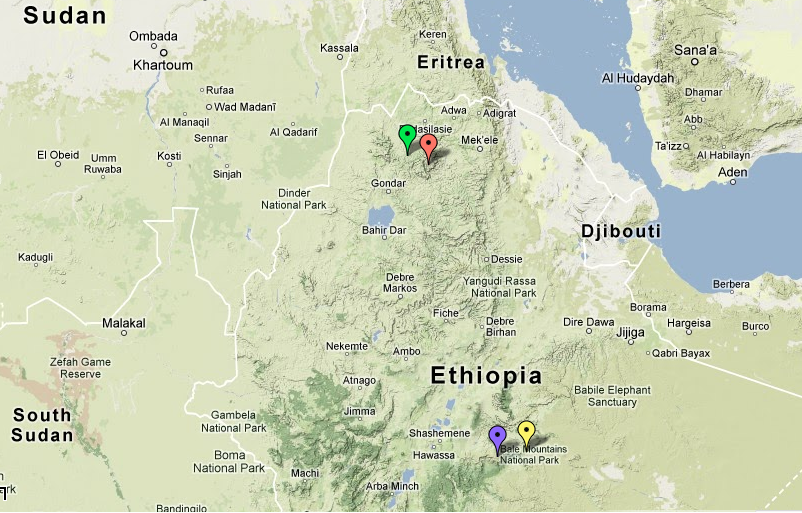
Melkibuta is probably a typo for Melkabuta, Bale, close to Goro, Bale which I have used as a proxy town in the map below for the location of the LA Oromo samples. 
Green= Low Altitude Amhara, Orange = High Altitude Amhara , Yellow = Low Altitude Oromo, Purple = High Altitude Oromo


Regarding the STRUCTURE run it says:

This position is further supported by the Bayesian clustering analysis performed using the program STRUCTURE [85]. In this analysis, 3 different sets of 57652 SNPs were used to infer the ancestral composition of each population assuming 7 ancestral groups. The STRUCTURE plots clearly show that Ethiopian populations share ancestral components with sub-Saharan African and Middle Eastern populations falling in the middle of the ancestry gradient between these two groups of populations (Figure S2.”

and Interestingly:

We also calculated the haplotype diversity and compared it to that observed in the worldwide populations. Interestingly, the Oromo (0.822) and Amhara (0.810) haplotype diversity values are as high as or higher than the highest values [80] observed in the HGDP, i.e. Bantu (0.818), Biaka Pygmies (0.815), Yoruba (0.815) and Mandenka (0.807); this is true regardless of altitude (0.798 for HA Amhara; 0.803 for LA Amhara, 0.813 for HA Oromo, and 0.813 for LA Oromo).”


There is also an FsT based Global neighbor joining tree in the PDF with a familiar outcome.


Wednesday, November 7, 2012

An early and enduring advanced technology originating 71,000 years ago in South Africa

There is consensus that the modern human lineage appeared in Africa before 100,000 years ago1,2. But there is debate as to when cultural and cognitive characteristics typical of modern humans first appeared, and the role that these had in the expansion of modern humans out of Africa3. Scientists rely on symbolically specific proxies, such as artistic expression, to document the origins of complex cognition. Advanced technologies with elaborate chains of production are also proxies, as these often demand high-fidelity transmission and thus language. Some argue that advanced technologies in Africa appear and disappear and thus do not indicate complex cognition exclusive to early modern humans in Africa34. The origins of composite tools and advanced projectile weapons figure prominently in modern human evolution research, and the latter have been argued to have been in the exclusive possession of modern humans56. Here we describe a previously unrecognized advanced stone tool technology from Pinnacle Point Site 5–6 on the south coast of South Africa, originating approximately 71,000 years ago. This technology is dominated by the production of small bladelets (microliths) primarily from heat-treated stone. There is agreement that microlithic technology was used to create composite tool components as part of advanced projectile weapons78. Microliths were common worldwide by the mid-Holocene epoch, but have a patchy pattern of first appearance that is rarely earlier than 40,000 years ago910, and were thought to appear briefly between 65,000 and 60,000 years ago in South Africa and then disappear. Our research extends this record to ~71,000years, shows that microlithic technology originated early in South Africa, evolved over a vast time span (~11,000years), and was typically coupled to complex heat treatment that persisted for nearly 100,000years. Advanced technologies in Africa were early and enduring; a small sample of excavated sites in Africa is the best explanation for any perceived ‘flickering’ pattern.

Closed Access