Below are more East African mtDNA bar graphs from the Hirbo Thesis, the complementary YDNA charts can be seen in this post, along with the Boattini paper featured here, this gives us a more complete picture of East African mtDNA with a reasonable amount of detail.
Google Visualization API has been having problems for the past couple of months, so the tool tips as well as other functionalities of Google charts may not work, this post will be updated if they fix some of these issues.
With respect to some of the data points, the populations labeled with a * had their total number of samples adjusted in order for the percentages shown in Table 3.4.1 to make sense, that is, Orma has been adjusted from 20 to 21, Marakwet from 22 to 23, Pokot from 39 to 38, San from 11 to 12 and Bamoun from 18 to 20.
Showing posts with label Chadic. Show all posts
Showing posts with label Chadic. Show all posts
Monday, December 9, 2013

Thursday, March 7, 2013
African Sahel YDNA
Multiple and differentiated contributions to the male gene pool of pastoral and farmer populations of the African Sahel
ABSTRACT
The African Sahel is conducive to
studies of divergence/admixture genetic events as a result of its
population history being so closely related with past climatic changes.
Today, it is a place of the co-existence of two differing food-producing
subsistence systems, i.e., that of sedentary farmers and nomadic
pastoralists, whose populations have likely been formed from several
dispersed indigenous hunter-gatherer groups. Using new methodology, we
show here that the male gene pool of the extant populations of the
African Sahel harbors signatures of multiple and differentiated
contributions from different genetic sources. We also show that even if
the Fulani pastoralists and their neighboring farmers share high
frequencies of four Y chromosome subhaplogroups of E, they have drawn on
molecularly differentiated subgroups at different times. These
findings, based on combinations of SNP and STR polymorphisms, add to our
previous knowledge and highlight the role of differences in the
demographic history and displacements of the Sahelian populations as a
major factor in the segregation of the Y chromosome lineages in Africa.
Interestingly, within the Fulani pastoralist population as a whole, a
differentiation of the groups from Niger is characterized by their high
presence of R1b-M343 and E1b1b1-M35. Moreover, the R1b-M343 is
represented in our dataset exclusively in the Fulani group and our
analyses infer a north-to-south African migration route during a recent
past.
Closed Access
Closed Access
 |
| Y(x CF) Phylogeny, Red = SNPs Tested, Blue =Presumed Tested |
 |
| CF Phylogeny, Red = SNPs Tested, Blue =Presumed Tested |
Monday, February 4, 2013
A speculative superimposition of E-M35 variants onto Afroasiatic.
Here is a speculative superimposition of the variants of YDNA E-M215/M35 (E1b1b/1) onto an Afroasiatic internal classification, Lionel Bender's (1997) classification.

The red question marks represent a less unsure fit.

Friday, June 22, 2012


Thursday, March 8, 2012
Afrasans in a Genome-Wide context.
A subset of the Intra-African dataset I
have includes Afrasans, or Afroasiatic speakers. Afroasiatic is
typically divided into 6 major categories or groups; Semitic, Berber,
Egyptian, Chadic, Cushitic and Omotic. A 7th, but nearly extinct group, known
as Ongota is contentious, but is by some included as its own branch
within the Afroasiatic phylum. All of these Language groups, with
the exception of Semitic, are exclusively found in Africa. The 211
Afrasan samples in the dataset belong to 4 or 5 of those groups mentioned,
depending on how one accounts for any language shifts (that is shifts
within the wider Afrasan phylum) that might have occurred. A rough
table is shown below associating the 211 samples with current, and in
some cases previously spoken language or language groups of
Afroasiatic.

In general, Afroasiatic is thought to
have emerged somewhere in the North Eastern section of Africa,
anywhere from Ethiopia to Southern Egypt, in the genetic (Autosomal)
sense, this area can perhaps be viewed as where
such populations inhabiting that area in Africa, lie along a diagonal axis of the C1 vs C3 Intra- African MDSplot (at ~
34°
from the horizontal), as highlighted below:
MDS plots
After extracting the 211 AA speaking
samples from the 1065 sample African Dataset, I performed an MDS Analysis on
it as seen below.


Component 1 separates
Berber/Semitic/Egyptian speakers from Chadic speakers, with Ethiopian
Semitic/Cushitic speakers plotting somewhere in between, but closer
to the former in this separation. Component 2, separates Ethiopians+Egyptians from the rest.

Component 3 Separates the Mozabites
from the Rest, with Ethiopians again retaining an intermediate
position.
Model Based Analysis
The Logical value for a K selection
would be 6, i.e. equivalent to the number of known Afroasiatic
subgroups, however, since Omotic speakers are not present in the
Dataset, I went ahead and run a K=5 unsupervised ADMIXTURE Analysis
for the Afrasan Dataset.
The K=5 ADMIXTURE run produced the
following FST distances,

The biggest separation for both Axis is
for the cluster I nicknamed Cushitic, while the Berber, Semitic and
Mozabite clusters appear pretty close, with the Mozabites looking a
bit isolated.
The Median proportions for the clusters
can be seen below.

The fact that the mozbites formed their
own cluster, is intriguing, although one would suspect that
inbreeding may play a role, since it can also be seen how the Mozabites
cluster away from other North Africans in the 3D MDS plot, almost
forming their own group.
Therefore, to see what this analysis would
look like without the Mozabites, I took all 27 of them out, leaving
me with 184 AA speaking samples.
I repeated the same analysis as above on the
newer Dataset.
MDS Plots


Components 1 and 2 behaved the same way
as when the Mozabites were included, Component 3 however, without the
Mozabites, separates Berber and Cushitic speakers from the rest to almost the same
degree, unlike when the Mozabites were included.
Model Based Analysis

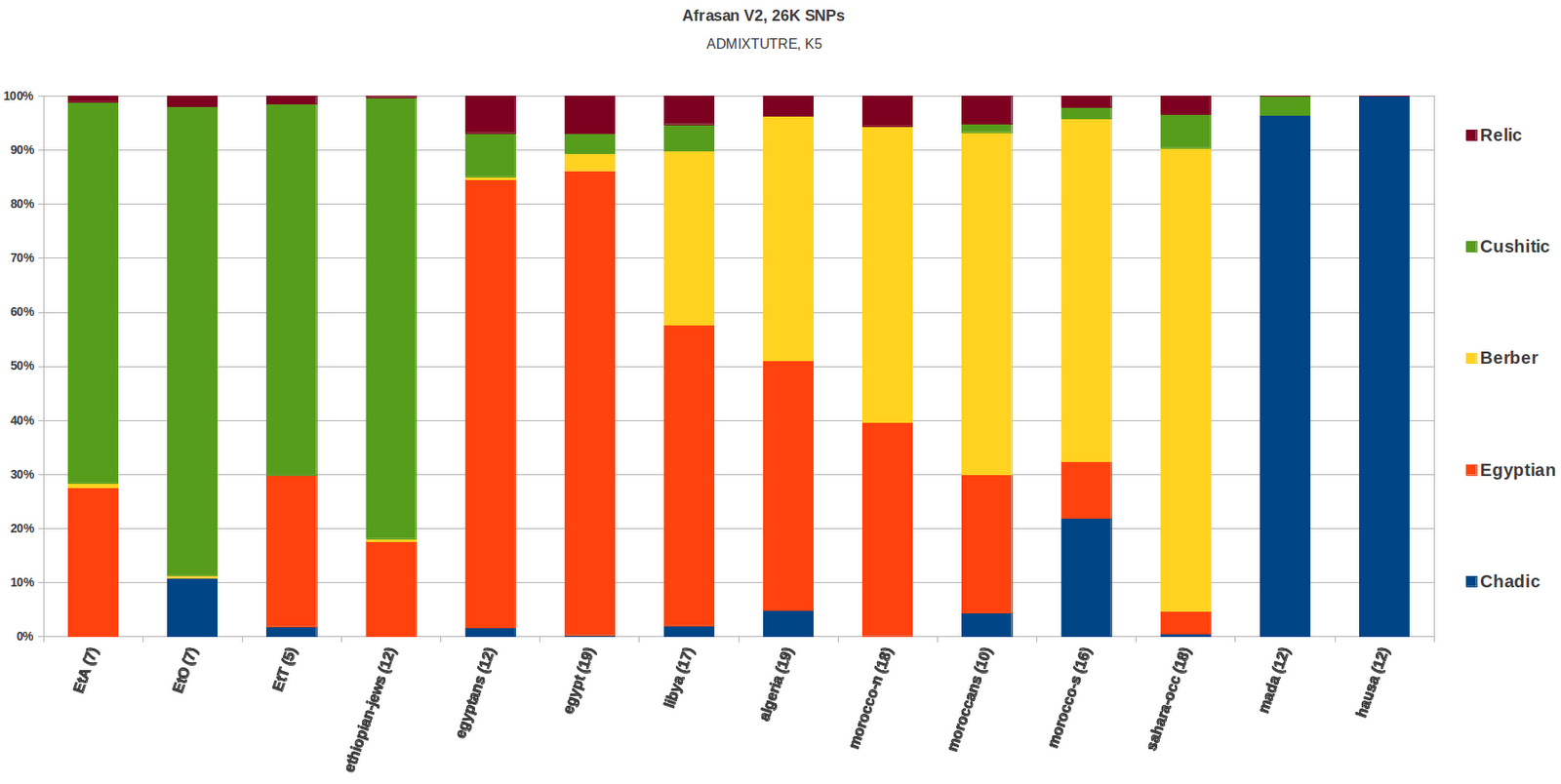
This second iteration of the Afrasan dataset that did not include the Mozabites
created a Cushitic, Chadic, Berber and Egyptian clusters, with a 5th
cluster which looked like a relic that is present in trace amounts in
all the Afrasan samples except the Mada and Hausa. The Egyptian
cluster is also found in highland Ethiopians, it also shows a more frequent occurrence of
high Standard Deviation relative to all the other clusters;

So the Egyptian cluster looks like it
gives less of a linguistic signal than the other clusters, it could
potentially be inclusive of a Semitic signal as well as maybe other
types of non-Afroasiatic Eurasian affinities.
It would be of great interest to see where
Omotic speakears would fit into this analysis.
Subscribe to:
Posts (Atom)

 Posts
Posts


